



Most UNESCO World Heritage Sites in India are ancient temples, forts or caves. They remind us of kings, dynasties and civilizations that flourished hundreds or even thousands of years ago. Chandigarh is different. It is a city born in independent India and does not stand out as part of British legacy. Instead of old stone walls and ancient palaces, it is known for its wide roads, open spaces, beautiful gardens and modern buildings. At the heart of this planned city stands one of the greatest architectural achievements of the twentieth century—the Capitol Complex, designed by the world-famous architect Le Corbusier. It is this remarkable work that earned India a place in UNESCO’s list of World Heritage Sites.
The story of Chandigarh begins with one of the most difficult periods in India’s history. When India gained independence in 1947, the state of Punjab was divided between India and Pakistan. The historic city of Lahore, which had served as Punjab’s capital for centuries, became part of Pakistan. India suddenly found itself without a capital for the reorganized state of Punjab. Prime Minister Jawaharlal Nehru wanted more than just a new administrative centre. He wanted a city that represented the hopes of a young nation.
Nehru famously described Chandigarh as a city that would be “unfettered by the traditions of the past” and an expression of the nation’s faith in the future. It was to be modern, efficient and full of optimism.
The Government of India selected a site at the foothills of the Shivalik Hills. American planner Albert Mayer initially prepared the city’s master plan. However, after the death of his colleague, the project was handed over to the celebrated Swiss-French architect Le Corbusier in 1951. His ideas transformed Chandigarh into one of the world’s finest examples of modern urban planning.
Le Corbusier was already one of the most influential architects of the twentieth century. He believed that cities should be carefully planned with plenty of sunlight, fresh air and green spaces. Buildings, according to him, should be simple, functional and beautiful without unnecessary decoration. His ideas changed architecture across Europe, America and Asia, and Chandigarh became his greatest work in India.
Walking through Chandigarh, one immediately notices that everything seems well planned. The city is divided into self-contained sectors, each with schools, markets, parks and community spaces. The roads are broad and lined with trees. Traffic moves smoothly because different types of roads were designed for different purposes. Even after more than seventy years, the city continues to be admired for its clean layout and quality of life.
The most important part of Chandigarh is the Capitol Complex. Spread over a vast open area, it houses the buildings that symbolise democracy and governance. These include the High Court, the Legislative Assembly, the Secretariat, the Open Hand Monument, the Geometric Hill, the Tower of Shadows and several other structures.
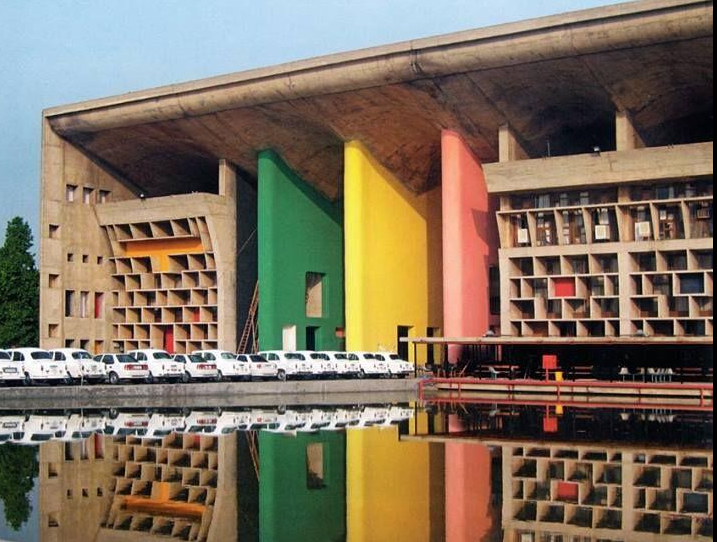
The High Court is perhaps the first building that catches the eye. Its colourful façade and enormous curved roof make it unlike any court building in India. The huge roof acts like an umbrella, protecting the building from the harsh summer sun while allowing natural light and ventilation.
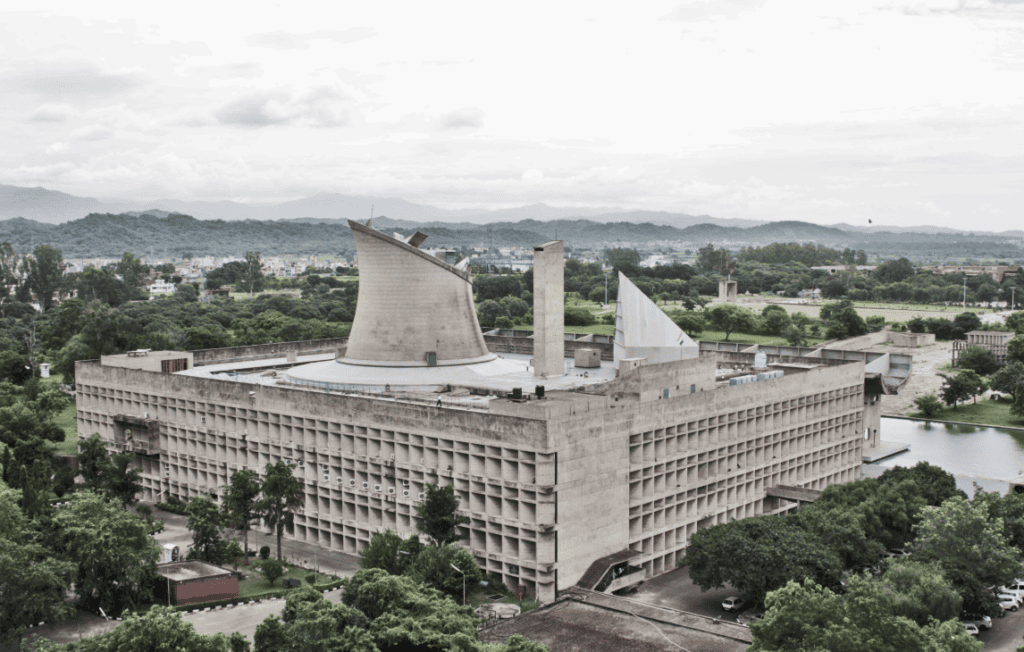
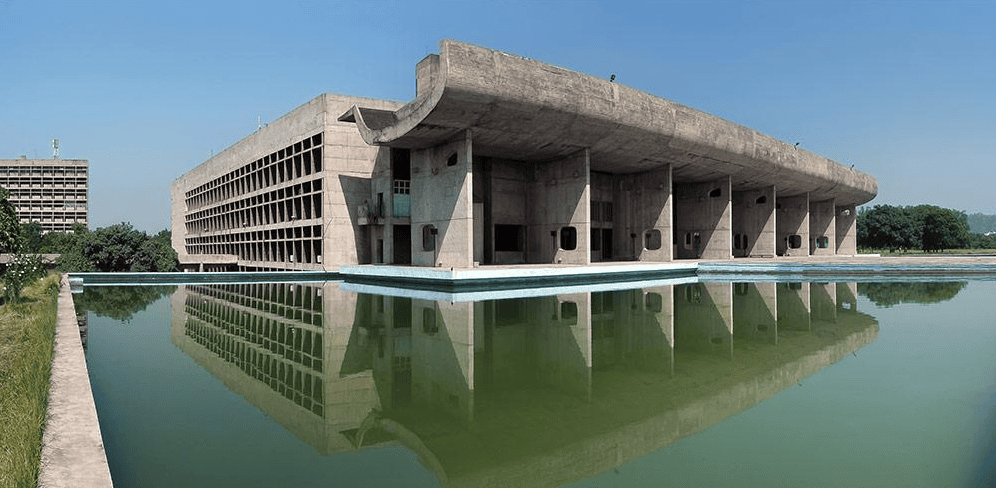
The Legislative Assembly is equally striking. Inside is a massive assembly hall where important laws have been debated for decades. The building’s bold geometric forms and towering structures reflect Le Corbusier’s belief that public buildings should inspire confidence and dignity.
The Secretariat is one of the largest government office buildings in India. Though simple in appearance, it was carefully designed to make the best use of sunlight, shade and airflow. Long before the words “green building” became popular, Le Corbusier was designing structures that responded naturally to the local climate.
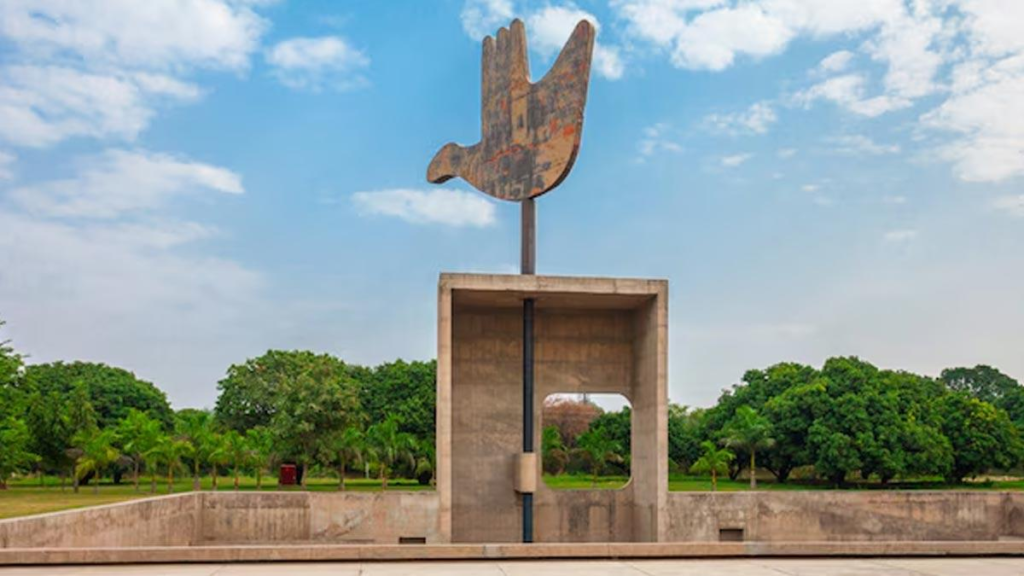
Perhaps the most meaningful symbol in the entire complex is the Open Hand Monument. Standing nearly 26 metres tall, the giant metal hand rotates with the wind. Le Corbusier described it as a symbol of peace and reconciliation. According to him, the open hand meant, “open to give and open to receive.” It reflected the idea that societies become stronger by sharing knowledge, ideas and friendship.
One of the most fascinating things about the Capitol Complex is that it does not depend on expensive decoration. There are no intricate carvings or marble inlays. Instead, beauty comes from clean lines, open spaces, natural light and perfect proportions. Concrete, which was once considered an ordinary building material, was transformed into works of art through thoughtful design.
It was these qualities that earned the Capitol Complex recognition as a UNESCO World Heritage Site in 2016. Interestingly, the site is part of a larger UNESCO inscription called “The Architectural Work of Le Corbusier – An Outstanding Contribution to the Modern Movement.” This World Heritage Site includes 17 buildings spread across seven countries, including France, Switzerland, Belgium, Germany, Argentina, Japan and India. Chandigarh is India’s contribution to this remarkable international collection.
UNESCO recognised the Capitol Complex because it represents a turning point in the history of modern architecture. It demonstrated how architecture could respond to changing societies after the Second World War. UNESCO also appreciated how Le Corbusier successfully combined modern design with India’s climate, culture and democratic values. The Capitol Complex is not merely a group of government buildings. It is a symbol of a newly independent nation looking confidently towards the future.
A visit to Chandigarh offers much more than the Capitol Complex. The city itself is an attraction. The beautiful Sukhna Lake is a favourite place for morning walks, boating and birdwatching. The famous Rock Garden, created by Nek Chand, is unlike any other park in the world. Built almost entirely from discarded materials such as broken tiles, old bangles, ceramics and industrial waste, it proves that creativity can transform even waste into beauty. The colourful Zakir Hussain Rose Garden, home to thousands of varieties of roses, is another peaceful place that attracts visitors throughout the year.
Reaching Chandigarh is very convenient. The city has an international airport with regular flights from Delhi, Mumbai, Bengaluru, Hyderabad and many other cities. Chandigarh Junction is well connected by rail, while excellent highways link it with Delhi, Shimla, Amritsar and other major destinations. The best time to visit is from October to March, when the weather is cool and pleasant.
Visitors could also explore the rich handicrafts of the region. Chandigarh and nearby Punjab are famous for beautifully embroidered Phulkari textiles. Bright colours and intricate floral designs make these shawls, dupattas and dress materials popular across India. The nearby town of Mohali offers traditional Punjabi juttis, while local markets sell handcrafted wooden products, handmade pottery and decorative home furnishings. These crafts reflect the warmth and artistic traditions of Punjab and Haryana.
Unlike many UNESCO sites that celebrate India’s ancient past, Chandigarh tells the story of a modern nation filled with hope and ambition. It reminds us that heritage is not only about old monuments. Sometimes, even concrete buildings and carefully planned streets become part of history because they change the way people think about architecture and city planning.
As the evening sun casts long shadows across the Capitol Complex, the buildings glow with quiet elegance. There are no crowds of pilgrims or tales of kings and battles. Instead, there is a different story—a story of vision, innovation and the dream of building a better India after Independence. Chandigarh is more than a city. It is a living lesson that great architecture can shape not only skylines but also the future of a nation.