



S N Poojitha

Running all along the western coastline of India is a mountain range that quietly shapes the lives of millions of people. The Western Ghats are not just a chain of mountains. They are one of the richest biodiverse regions in the world. They influence the Indian monsoon, feed some of the country’s most important rivers and shelter thousands of species of plants and animals. Spanning about 1,600 kilometres from Gujarat to the southern tip of India, the Western Ghats pass through Gujarat, Maharashtra, Goa, Karnataka, Kerala and Tamil Nadu. In 2012, UNESCO recognised parts of this extraordinary landscape as a World Heritage Site.

Unlike a single monument such as a fort or temple, the Western Ghats are a series of UNESCO World Heritage spots. The UNESCO property consists of 39 protected areas grouped into seven clusters. These include national parks, wildlife sanctuaries and reserved forests spread across six states. Together, they represent some of the finest examples of the natural wealth of the Western Ghats.

The Western Ghats are also much older than the Himalayas. Their geological history goes back hundreds of millions of years. The mountains were shaped by major changes in the Earth’s landmasses and by the movement of the Indian Plate. Over a very long period, isolation, changing climate and different landscapes allowed species to evolve in their own unique ways. This is one reason why so many plants and animals found here are endemic, meaning they are found nowhere else in the world. UNESCO considers this evolutionary history one of the important reasons for the site’s global value.
One of the most important roles played by the Western Ghats is in India’s monsoon system. The mountains run almost parallel to the western coast. When moisture-filled winds arrive from the Arabian Sea, the Ghats force these winds upwards. This produces heavy rainfall on the western side and influences the climate of the entire peninsula. The forests of the Ghats therefore do much more than create beautiful landscapes. They help regulate the climate and water cycle of a large part of India. UNESCO describes the region as one of the world’s best examples of the interaction between mountain ecosystems and the tropical monsoon system.
The forests also act as enormous natural water reserves. Several important rivers originate in or around the Western Ghats. The Godavari, Krishna and Kaveri rivers, among others, depend on rainfall and water flows associated with this mountain region. Rivers and streams emerging from these forests provide water for agriculture, towns and cities across southern and western India.
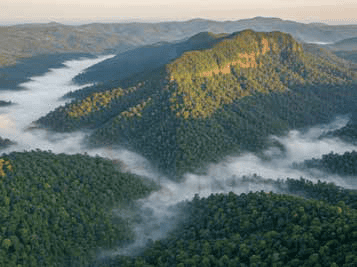
The biodiversity of the Western Ghats is extraordinary. UNESCO records thousands of plant species in the region, with a particularly high proportion of endemic species. Around 54 per cent of the tree species recorded in the Western Ghats are endemic. The region is equally remarkable for its amphibians, reptiles and freshwater fish. Many of these species are found only in this part of the world.
Some of the most fascinating animals of the Western Ghats are rarely seen by visitors. The lion-tailed macaque, with its silver-white mane and distinctive tail, lives in the evergreen forests of the region. The Nilgiri tahr, a mountain goat-like animal, is found on the high grasslands of the southern Ghats. The Nilgiri langur is another species closely associated with these forests. Tigers, leopards, elephants and gaurs also inhabit different parts of the mountain range.
Perhaps the most unusual creatures are the amphibians. The Western Ghats are famous for their frogs, many of which are extremely small and have been discovered only in recent decades. Some species live in tiny areas and are found nowhere else. This means that the destruction of even a small patch of forest can threaten species that may exist in no other part of the world.
The region is also famous for its Shola forests and grasslands. These high-altitude ecosystems are especially important in the Nilgiri and southern Western Ghats. From a distance, the landscape may appear to be nothing more than green hills. But the forests hidden between the grasslands contain a remarkable variety of life. The region also has unusual wetland habitats such as Myristica swamps, which are remnants of ancient ecosystems and are among the rarest forest types in India.
There is another fascinating natural phenomenon associated with the Western Ghats. Some areas experience spectacular mass flowering events. Certain plants remain unnoticed for years and then suddenly cover the grasslands with flowers during a particular season. The famous Neelakurinji, for example, is known for flowering in cycles and transforming sections of the Nilgiri landscape into a carpet of purple. Such events attract visitors but are also important to scientists studying plant cycles and mountain ecosystems.
The Western Ghats have also shaped the culture and traditions of the communities living around them. Forests have provided food, medicines, honey, timber and other resources for generations. Many indigenous communities have developed detailed knowledge of local plants and animals. Sacred groves are another fascinating tradition found in parts of the region. These small patches of forest are protected because of their religious and cultural importance. In many cases, they have helped preserve trees and plants that disappeared from surrounding areas.
The Western Ghats are therefore not recognised simply because they are beautiful. Their importance is much deeper. They represent an evolutionary laboratory, a water source, a climate regulator and a refuge for rare species. Their UNESCO status is a recognition of this global importance.
For travellers, the Western Ghats offer an enormous variety of experiences. In Karnataka, visitors can explore places such as Kudremukh, Agumbe, Kodagu and the forests around Chikkamagaluru. Kerala offers destinations such as Munnar, Wayanad and the Silent Valley region. In Tamil Nadu, the Nilgiris, Ooty and surrounding protected forests provide spectacular mountain landscapes. Goa and Maharashtra also have beautiful forest sections of the Ghats, including the areas around Mahabaleshwar and the Sahyadri ranges.
The best time to explore the Western Ghats depends on the destination. The monsoon months bring spectacular waterfalls, mist and lush greenery, but heavy rainfall can make trekking difficult. The period between October and March is generally more comfortable for travel, wildlife watching and trekking in many parts of the region. Visitors should always check local forest regulations because many protected areas have restricted access.
The Western Ghats face growing pressure from roads, tourism, urbanisation, mining, agriculture and other development activities. UNESCO itself has highlighted the importance of reducing the impact of infrastructure and maintaining ecological connections between protected areas. The challenge is to allow development while ensuring that forests remain connected and wildlife can continue to move across landscapes.
The Western Ghats remind us that some of India’s greatest treasures are not built by human hands. They are living landscapes that have taken millions of years to evolve. Every river that begins in its forests, every rare frog found under its leaves and every elephant moving through its valleys is part of a much larger story.
The mountains in the Western Ghats can appear timeless and unchanging. But their future depends on choices being made today. The UNESCO recognition is therefore not merely a badge of honour. It is also a reminder of responsibility. The Western Ghats belong not only to the states through which they pass, but to the ecological heritage of India and the world. Protecting them means protecting forests, rivers, wildlife and ultimately the lives of millions who depend on them.