


There has been a noticeable shift in the technology job market especially over the past two to three years, both globally and in India. Layoffs, which were once seen as occasional corrections, have now become a recurring feature of the industry. What is different this time is the underlying reason. While economic slowdown, over-hiring and pandemic played a role in the past, a major driver now is the rapid adoption of artificial intelligence (AI) tools, including systems like advanced coding assistants, large language models and what is increasingly referred to as “vibe coding,” where much of the programming work is assisted or automated by AI and detailed coding knowledge may not be required.

Across the world, large technology companies have reduced their workforce at scale. Companies like Amazon, Microsoft, Google, and Intel together cut over 100,000 jobs in 2025 alone, as they restructured around automation and AI-led efficiency. At least eight major global firms including Accenture and Dell, announced layoffs affecting more than 10,000 employees each, with AI adoption being one of the key factors behind these decisions. Even when companies do not directly attribute layoffs to AI, the pattern is clear: investment is shifting towards automation, while routine roles are being reduced.
India has not been insulated from this trend. The country’s IT sector, which has traditionally been a large employment generator, is going through a phase of adjustment. Major firms such as Tata Consultancy Services, Infosys, Wipro and LTI Mindtree have either reduced headcount or slowed hiring, especially at the entry and mid levels. Experts estimate that thousands of jobs have been cut or rationalised in recent years as companies focus more on AI, cloud, and automation-based services. TCS alone announced layoffs of around 12,000 employees, one of the largest reductions in the Indian IT sector. Global companies with large India presence, such as Oracle, have also reduced workforce as they pivot towards AI-driven solutions.

Startups and smaller companies are also part of this shift. Firms like Ola Electric, Zepto, and CARS24 have cut jobs as they try to become more efficient and reduce costs. In many of these cases, automation tools are replacing repetitive roles in customer service, operations and even parts of software development. The impact is not always dramatic in a single instance, but when seen across the ecosystem, it reflects a broader structural change.
Recent news reports also confirm that layoffs continue into 2026. For example, large firms like Oracle and Amazon have initiated further job cuts, while India’s top IT companies together reduced thousands of jobs in the current financial year reflecting a shift towards productivity gains rather than headcount growth. The emphasis is clearly moving from “more employees” to “more output per employee,” enabled by AI tools.
At the core of this change is the nature of work in software and IT services. For decades, India’s advantage was built on large teams handling coding, testing, maintenance and support work. Many of these tasks were repetitive and are being standardised. Today, AI systems can generate code, test software, debug issues and even manage workflows at a speed and scale that reduces the need for large teams. Tasks that earlier required several engineers over days can now be completed in minutes using AI-assisted tools.
This does not mean that all jobs are disappearing, but it does mean that the type of jobs is changing. There is a clear reduction in demand for routine, entry level roles, while demand is increasing for higher-skill roles such as AI engineering, system design, product management, and cybersecurity. The transition, however, is not smooth. There is a gap between the skills that are being reduced and the skills that are being created.
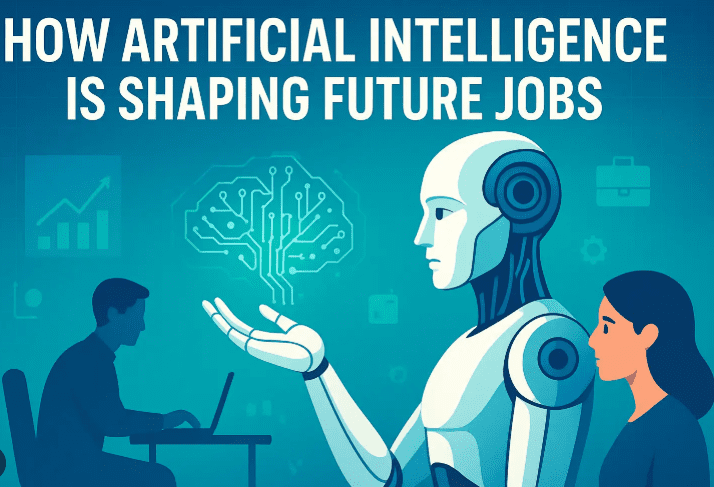
From an analytical perspective, this can be seen as a shift from labour-intensive growth to productivity-led growth. Earlier, revenue growth in IT companies was closely linked to hiring more people. Now, with AI tools increasing productivity, companies can deliver the same or higher output with fewer employees. This changes the basic employment model of the sector. Data suggests that even as revenues remain stable or grow slowly, headcount is no longer increasing at the same rate, and in some cases is declining.
Another important aspect is the concept of “automation bias” in companies. When a new technology like AI becomes available, firms tend to adopt it quickly to remain competitive. This leads to a situation where even if full automation is not necessary, companies still reduce workforce to align with industry trends. Over time, this creates a cycle where efficiency improvements lead to further reductions in hiring.
For India, the impact is significant because of the scale of employment in the IT and services sector. Millions of young graduates enter the job market each year with expectations of software or IT-related roles. If entry-level hiring slows down, it creates pressure not just on individuals but also on the broader economy, especially in urban areas where consumption is driven by salaried employment.
At the same time, it would be incomplete to view AI only as a threat. Historically, every major technological shift has created new types of jobs even as it eliminated older ones. AI is likely to follow a similar pattern. New roles in data science, AI model training, prompt engineering and human-AI interaction are already emerging. There is also increasing demand for roles that require creativity, decision-making and domain understanding, which AI cannot fully replicate at present.
The challenge lies in the transition period. Workers who are currently in roles that are being automated need to reskill quickly to remain relevant. Companies, educational institutions and policymakers all have a role to play in facilitating this shift. Without adequate support, there is a risk of a mismatch between available jobs and available skills.
Looking ahead, the future of employment in software in India is likely to be different from its past. The sector will continue to grow, but not necessarily in terms of headcount. Growth will be driven more by innovation, specialised skills, and high-value work rather than large-scale hiring. Entry-level roles may become fewer, but more skilled roles will become more important.
****
In simple terms, the industry is moving from a model based on quantity to one based on quality. For individuals, this means focusing more on learning and adaptability. For companies, it means balancing efficiency with long-term talent development. And for the country as a whole, it means recognising that while AI brings efficiency, it also requires careful planning to ensure that employment opportunities continue to grow in a meaningful way.