


S N Poojitha

There are singers who are remembered for their songs. There are others whose voices become part of the memories of an entire generation. And then there are a rare few whose music seems to acquire a life of its own and live for eternity. M. S. Subbulakshmi belonged to that last category.
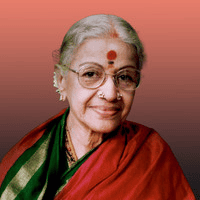
For millions of Indians, her voice was not simply the sound of a concert. It was the sound of early mornings, temple and devotional gatherings, and quiet moments of prayer. Her renditions of Venkateswara Suprabhatam, Vishnu Sahasranamam, Bhaja Govindam and numerous Carnatic compositions travelled far beyond the traditional concert hall.
Yet her story is much larger than that of a great singer. It is a story of extraordinary talent, discipline, cinema, devotion, social change, international recognition and philanthropy. M. S. Subbulakshmi helped take Carnatic music to audiences who had never encountered it, while retaining the depth and discipline of the tradition in which she had been trained.
She was born on 16 September 1916 in Madurai, Tamil Nadu, and was affectionately called Kunjamma at home. Her mother, Shanmukhavadivu, was a respected veena player and became her first important musical influence. Subbulakshmi grew up in an environment where music was not an occasional activity but part of everyday life.
Her talent appeared remarkably early. There is an interesting story from her childhood. On one occasion, her mother was performing at a musical gathering in Madurai while the young Kunjamma was outside, playing. Her mother suddenly announced that the little girl would sing. The child was brought before the audience and, without any apparent nervousness, performed a Marathi bhajan. The audience was astonished. It was an early indication that this was not simply a child who could sing. There was something distinctive about the voice and the confidence behind it. That little girl who had been playing outside would eventually become one of India’s most celebrated musicians.
Her formal musical training began early. She learnt Carnatic music under several accomplished teachers and developed a strong foundation in raga, rhythm, pronunciation and the structure of classical compositions. But technical ability alone does not explain her rise. Subbulakshmi possessed a voice of unusual clarity and emotional power. Her singing could be deeply classical without becoming inaccessible. She could handle the complexities of Carnatic music while communicating the emotional meaning of a composition even to listeners who knew little about its technical structure.
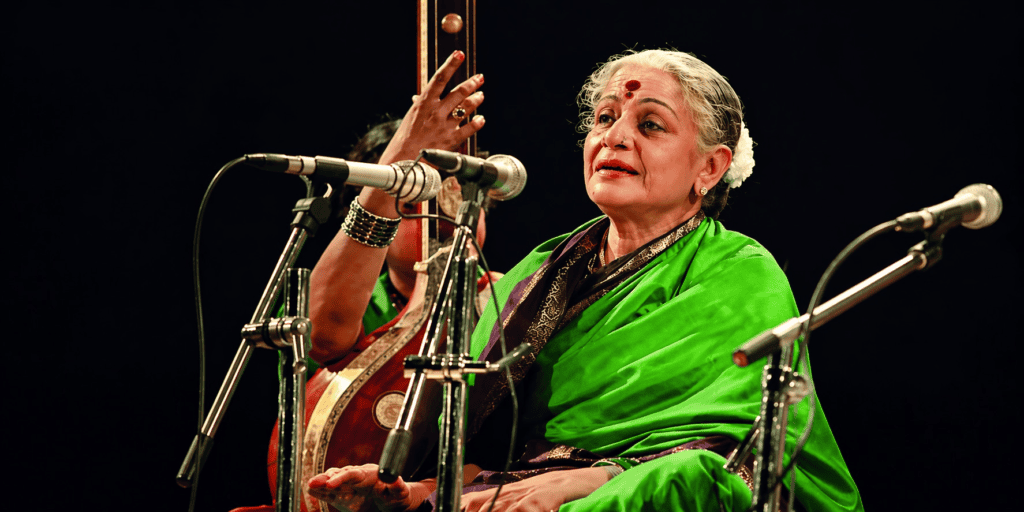
A major turning point came in 1932, when Subbulakshmi appeared at the Madras Music Academy at a remarkably young age. There is an interesting story behind the performance. She was not originally the main artiste scheduled for the programme. When the celebrated vocalist Ariyakkudi Ramanuja Iyengar could not attend, the young Subbulakshmi was given an opportunity to perform. The response was extraordinary. Among those who heard her were eminent musicians including T. N. Rajarathinam Pillai, Chembai Vaidyanatha Bhagavathar and Mysore T. Chowdiah. Her performance created such an impression that the young singer was suddenly being discussed as a serious musical talent. One of the most memorable compliments came from the legendary veena musician Karaikudi Sambasiva Iyer, who is said to have remarked that it was as though a veena was hidden inside her throat.
Subbulakshmi also entered the world of cinema. Her most famous film was Meera, in which she portrayed the medieval saint-poet and devotee of Lord Krishna. The film was first made in Tamil and later released in Hindi, taking her music to audiences far beyond the traditional Carnatic circuit.
There is a particularly beautiful story associated with the filming of Meera in Dwarka. While shooting there, Subbulakshmi visited places associated with the saint. During one sequence, she sang inside a Krishna temple. The atmosphere became deeply emotional. Subbulakshmi herself reportedly became overwhelmed while singing, with tears coming to her eyes. The elderly temple priest, who was described as partially blind, was also deeply moved. He began keeping rhythm with his hands and became absorbed in the devotional atmosphere.

The experience affected the film’s director, Ellis Duncan. He later felt that Subbulakshmi had gone beyond simply acting the part of Meera. Her devotion while singing had made the performance feel almost like an actual spiritual experience. This was perhaps the secret of her success in devotional music. She did not merely sing about devotion. She made listeners feel that she was experiencing it herself.
One of the remarkable aspects of Subbulakshmi’s career was the range of languages and traditions she embraced. She sang extensively in Tamil and Telugu and also performed Kannada compositions and Hindi bhajans. Her renditions of Bhaja Govindam, Vishnu Sahasranamam and Venkateswara Suprabhatam became particularly influential. Her recording of Venkateswara Suprabhatam became closely associated with the morning devotional tradition at Tirumala and entered millions of Indian homes.
There is another wonderful anecdote that captures the respect she commanded even among musicians from other traditions. When she performed in Bombay, she sang not only Carnatic compositions but also bhajans associated with Tulsidas, Mirabai and Guru Nanak. Among those who heard her was the legendary Hindustani vocalist Ustad Bade Ghulam Ali Khan. He reportedly described her as “Suswara Lakshmi”, meaning Lakshmi of the beautiful voice.
Subbulakshmi’s relationship with Mahatma Gandhi is one of the most memorable chapters of her life. Gandhi admired devotional music and particularly liked her rendition of the Meera bhajan Hari Tum Haro. In 1947, Gandhi wanted Subbulakshmi to sing the bhajan for him. There was a problem. She did not feel adequately prepared to perform the song and apparently suggested that someone else could sing it. Gandhi’s reported response was remarkable. He is said to have expressed that he would rather hear her speak the words than hear somebody else sing them. The song was eventually recorded and sent to him. The story captures something important about the way people responded to Subbulakshmi. Gandhi was not asking for a technically perfect performance from an anonymous singer.
But Subbulakshmi was known for her humility. Despite performing before Prime Ministers, royalty and international audiences, she remained remarkably unassuming. Her fame never became the centre of her personality. Her public contribution went beyond music. In the 1940s, her husband T. Sadasivam became closely involved in organising benefit performances. One important episode began when C. Rajagopalachari returned from Sevagram and told Sadasivam that he had promised Gandhi several benefit concerts by Subbulakshmi for the Kasturba Memorial Fund. Sadasivam accepted the responsibility. Those performances became part of a much larger tradition. Over the course of her career, Subbulakshmi performed more than 200 benefit concerts, raising money for educational, medical, religious and charitable causes.
Her charitable giving did not end with concerts. Royalties from some of her famous recordings were also directed towards public and religious institutions. Her Venkateswara Suprabhatam, for example, generated substantial royalties that were used for charitable purposes associated with Tirumala.
For much of the early twentieth century, Indian classical music remained unfamiliar to international audiences. Subbulakshmi helped change that. She performed at major international venues and festivals, including the Edinburgh International Festival and London’s Royal Albert Hall. She also performed before Queen Elizabeth II. But perhaps the most symbolic moment came in 1966, when she performed at the United Nations General Assembly in New York. Her programme included Maithreem Bhajatha, a Sanskrit composition associated with the Kanchi Paramacharya. The song carried a message of friendship, compassion and peace. The setting was significant. India was still a young republic, and its cultural identity was being introduced to the world in many different ways.
In 1998, she became the first musician to receive the Bharat Ratna, India’s highest civilian honour.
Behind the public figure was also a long partnership with her husband, T. Sadasivam. He played an important role in shaping and managing her career, helping organise her concerts, recordings and public engagements and taking her music to a wider audience. Their daughter Radha Viswanathan also became an important part of Subbulakshmi’s musical life. Radha accompanied her mother on stage for decades and became an accomplished musician in her own right. Together, they formed a close musical partnership that continued for many years.
M. S. Subbulakshmi passed away in Chennai on 11 December 2004, at the age of 88. Her performing career had ended, but her music never did. Young musicians continue to study her renditions, her recordings remain widely heard, and her name continues to represent the finest traditions of Indian classical music.
She had performed before Gandhi, Nehru, royalty and the United Nations. Yet her most enduring achievement may have been much simpler: she brought classical and devotional music into the lives of ordinary people. Her greatness lay not only in technical mastery, but in her ability to make music feel personal and deeply human. She did not merely carry Indian music to the world. She gave it a voice that the world could understand and never forget.