



The Union Budget 2026–27, presented by Finance Minister Nirmala Sitharaman in Parliament on 1 February 2026, outlines India’s fiscal strategy, economic priorities, and policy direction for the upcoming financial year. It marks her ninth successive budget, making her the first Finance Minister to achieve this milestone.
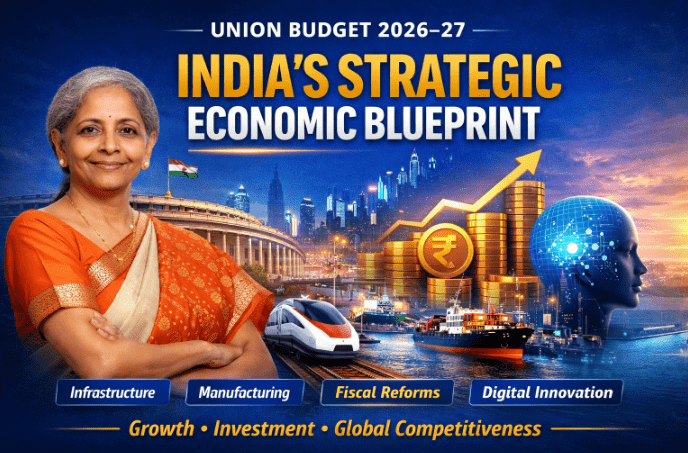
This Budget continues the Government’s emphasis on infrastructure-led growth, fiscal discipline, and manufacturing, aiming to strengthen long-term economic resilience and global competitiveness.
The Budget is anchored on a set of strategic goals that reflect both current needs and future aspirations of the Indian economy:
1. Infrastructure and Connectivity: A substantial expansion of public capital expenditure to ₹12.2 lakh crore supports transport, logistics, waterways, and urban growth.
2. Manufacturing & Strategic Sectors: Targeted initiatives to strengthen domestic production across semiconductors, biopharma, textiles, and critical minerals aim to reduce import dependence and expand global competitiveness.
3. Ease of Doing Business & Investment: Reforms to modernise taxation, foreign investment rules, and digital infrastructure are designed to attract private capital and simplify compliance.
4. Inclusive Growth: Support for MSMEs, rural development, and skill-building ensures broad-based participation in economic opportunities.
1. Infrastructure: The Main Growth Engine
The Budget places infrastructure at the heart of economic growth, with a record capital outlay designed to:
- Develop seven high-speed rail corridors, enhancing passenger mobility and regional integration. These proposed corridors will link major urban and economic centres, including Mumbai–Pune, Pune–Hyderabad, Hyderabad–Bengaluru, Hyderabad–Chennai, Chennai–Bengaluru, Delhi–Varanasi, and Varanasi–Siliguri—covering nearly 4,000 km of high-speed track.
- Operationalise 20 new national waterways to shift freight to greener and more efficient transport modes.
- Establish City Economic Regions (CERs) to foster urban economic clusters across Tier II and Tier III cities.
- Introduce an Infrastructure Risk Guarantee Fund to crowd in private investment by sharing project risks.
This push strengthens logistics, connectivity, and regional development, which are seen as foundational to lowering costs and attracting long-term investments.
2. Manufacturing & Strategic Industries
A major theme of this Budget is to boost manufacturing competitiveness across key sectors:
- Biopharma SHAKTI: A ₹10,000 crore, five-year initiative to position India as a global biopharmaceutical hub, with expanded clinical research infrastructure.
- Semiconductors & Electronics: Enhanced support under India Semiconductor Mission (ISM) 2.0 and a ₹40,000 crore outlay for electronics component manufacturing to deepen higher-value production.
- Textile Sector Modernisation: A multi-part integrated programme to support natural fibres, sustainable textile production, and skill upgradation.
- Rare Earth Corridors & Chemical Parks: Dedicated corridors and parks to strengthen upstream mineral supply chains and downstream manufacturing.
These measures aim to create resilient supply chains, foster innovation in the private sector, and secure India’s role in global industrial value chains.
3. Taxation & Fiscal Discipline
The Budget balances growth with fiscal prudence:
- Fiscal Deficit Target: Set at 4.3% of GDP for 2026–27, continuing the trajectory of gradual consolidation.
- Tax Reforms: Changes include lower Tax Collected at Source (TCS) rates for certain foreign remittances and extended tax holidays to attract digital infrastructure investments.
- Simplified Compliance: Revisions in filing timelines and relief provisions for foreign asset disclosures help ease compliance burdens.
- A major relief was provided in the health sector, with basic customs duty waived on 17 cancer drugs and exemptions on medicines for several rare diseases, helping reduce treatment costs.
- For individual consumers, the customs tariff on goods imported for personal use was reduced from 20% to 10%, making foreign purchases more affordable.
These adjustments aim to improve tax certainty, reduce litigation risk, and attract long-term capital flows.
4. Social & Digital Economy Initiatives
Beyond hard infrastructure, the Budget underscores human capital and digital growth:
- Encouraging a transition to AI-led innovation, especially in agritech and rural supply chains through programmes such as Bharat-VISTAAR.
- Supporting startups, data centres, and cloud services with long-term incentives aimed at making India a global tech hub.
- Enhancing education and employment linkages through dedicated committees and skill development programmes.
Overall, the Budget has been received with optimism for its wide-ranging announcements and forward-looking vision of the Government. However, on the taxation front, the announcement of higher Securities Transaction Tax (STT) on derivatives drew significant market criticism, triggering sharp stock market declines as traders expressed concerns over increased costs and reduced trading activity.