



Do not allow the pressure to secure a prestigious admission to turn into a lifelong mistake
As the academic year draws to a close, thousands of students aspiring for admission to medical, engineering, management and other professional courses begin preparing for entrance examinations and the admission process. For ambitious students and anxious parents, securing a seat in a reputed institution can become an overriding priority.
It is precisely at this stage that admission agents and middlemen often enter the picture.

Students who narrowly miss the required marks or rank may be tempted by promises of shortcuts. Parents, driven by the desire to see their children enter prestigious colleges, may also become vulnerable to such assurances. What begins as an attempt to secure a better educational opportunity can ultimately become a serious legal and financial problem.
One of the most dangerous shortcuts involves the misuse or fabrication of caste certificates and other educational documents. A student who is not entitled to a particular reservation category may be persuaded to obtain a false certificate in order to qualify for admission. Similarly, forged marksheets, examination records or other documents may be offered as a means of overcoming an eligibility requirement.
EXAMPLE: WHEN A FALSE CASTE CERTIFICATE BECOMES A CAREER NIGHTMARE:
Consider the case of a student who narrowly misses the cut-off for admission to a prestigious professional course. An agent assures the family that a seat can be secured if the student produces a caste certificate showing eligibility under a reserved category.
The student and parents, believing that this is merely a shortcut to admission, agree to the arrangement and pay a substantial amount to the intermediary. The student is subsequently admitted on the basis of the certificate.
The problem begins when the college or the authorities verify the certificate and discover that the candidate was not entitled to the claimed category. The admission may then be cancelled and the certificate may become the subject of an investigation. Depending on the facts and the applicable law, the student and others involved may face allegations relating to cheating, forgery or the use of false documents.
The family may lose not only the money paid to the intermediary but also the student’s valuable academic year. Legal expenses, court proceedings and the damage to the student’s reputation can add to the burden.
What initially appeared to be a clever way of securing a prestigious seat can therefore become a serious threat to the student’s entire career.
The lesson is simple: never allow an admission agent to persuade you that a false certificate is a harmless shortcut. A few marks may cost an admission, but a fraudulent certificate can cost far more.
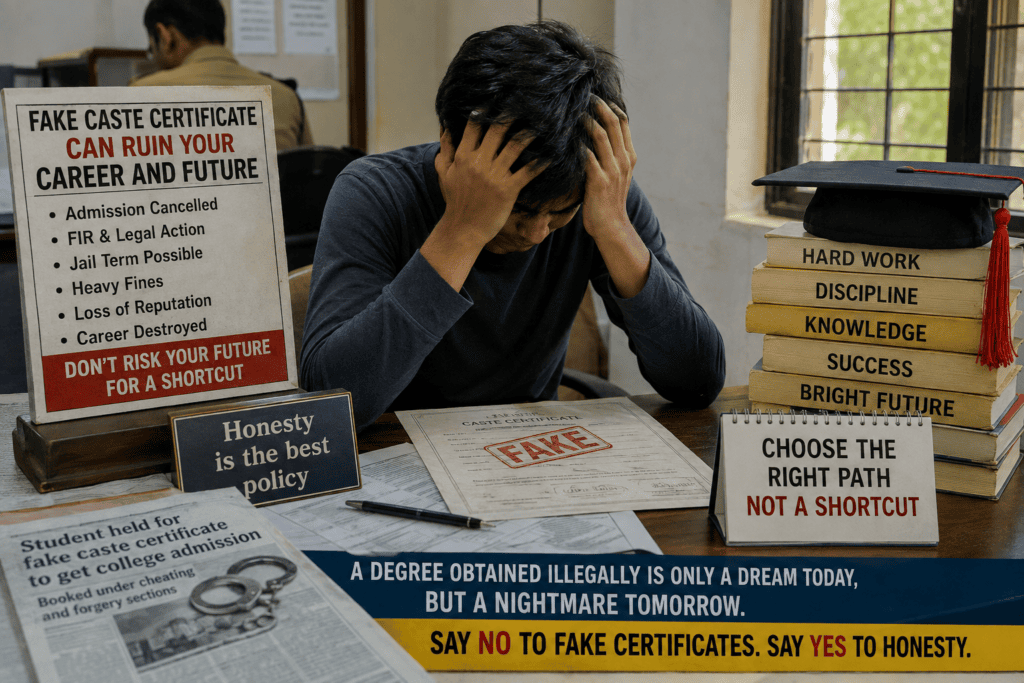
Such practices are not merely educational irregularities. Depending on the facts, the production or use of false documents can have serious legal consequences. An institution may cancel an admission obtained through fraudulent means and may report the matter to the authorities. Criminal proceedings can also follow where the conduct amounts to cheating, forgery, use of forged documents or other offences under the applicable law.
The consequences can extend far beyond the loss of a college seat.
A student may lose the money paid to an intermediary, donation or other admission-related expenditure. The family may then have to bear the additional cost of legal representation and court proceedings. More importantly, the student’s academic record and professional reputation may be seriously damaged.
A degree or qualification obtained through an admission procured by fraud can also become a source of continuing uncertainty. What appeared to be a shortcut to a successful career may instead become an obstacle that follows the student for years.
Students and parents therefore need to exercise extreme caution when dealing with people who promise guaranteed admission, reservation benefits, manipulated marks or certificates for a price. No prestigious college or professional qualification is worth compromising one’s legal standing and future.

Parents, in particular, should resist the temptation to fulfil every demand made by their children merely because they fear that the child may lose an opportunity. Missing admission by a few marks, attending another college, taking another attempt or choosing a different course is far less damaging than facing an investigation or criminal prosecution arising from fraudulent documents.
The temptation of a shortcut is understandable, but its consequences may not be reversible.
A missed admission can be recovered. A lost reputation and a criminal case may be much harder to overcome.
Students should therefore choose merit, legitimate reservation rights and lawful admission procedures over the promises of middlemen. Parents too must ensure that ambition does not become an excuse for indiscretion.
In education, as in life, a legitimate second chance is far better than an illegal shortcut.
C.K. SUBRAMANIAM
Navi Mumbai

Navi Mumbai