



“Citizenship is the right to have rights.”
By Advocate Labdhi Jain
Rajasthan High Court
A passport is more than a travel document. It is the State’s promise that you belong. Issued after rigorous verification, it allows you to cross borders under the protection of your country and serves as one of the strongest symbols of national identity. But what happens when the very State that issued the passport says it is not proof of your citizenship? Can a government recognize you today and question your belonging tomorrow?
By Adv
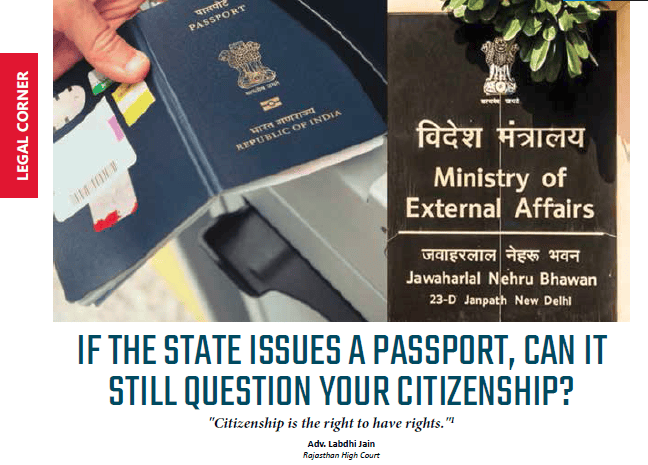
The question is no longer hypothetical. According to Passport Seva, the Government of India rendered over 1.40 crore passport and passport-related services within India in 2025, underscoring the passport’s significance as one of the country’s most widely relied-upon government-issued documents. Yet the Ministry of External Affairs (MEA) recently clarified before the Delhi High Court that an Indian passport is only a travel document and not conclusive proof of citizenship.
The clarification has reignited a fundamental constitutional debate. If citizenship can be questioned despite the State issuing one of its highest official documents, what does a passport truly signify? Is citizenship merely an administrative status that can be revisited, or is it a constitutional bond that cannot be unsettled without due process? The answers lie at the intersection of statutory law, constitutional guarantees, and the enduring relationship between the citizen and the State.
The Sovereign Identity Crisis
From the standpoint of the ordinary citizen, a passport is widely regarded as the ultimate symbol of citizenship. Yet the Ministry of External Affairs (MEA) has sparked an apprehensive debate throughout the country by declaring that the Indian passport is merely a travel document and not conclusive proof of Indian citizenship.
This clarification has led many to ponder what it truly means to be an Indian citizen. Today, Aadhaar serves as proof of identity, the voter ID establishes electoral identity, and the passport is indispensable for international travel. After requiring citizens to undergo police verification, biometric authentication, and extensive scrutiny before issuing a passport, informing them that the same document is insufficient to establish citizenship appears deeply contradictory.
Such a position reduces citizenship from a constitutional relationship into an administrative label that may be questioned at any time. It weakens the idea of nationality as a secure legal bond between the individual and the State and instead portrays it as a status that remains perpetually subject to executive scrutiny.
Citizenship on Paper: What Indian Law Actually Says
The legal position is equally complex. Section 20 of the Passports Act, 1967 provides very limited scope for issuing passports to non-citizens. This naturally raises an important question: if Aadhaar is proof of identity, the voter ID reflects electoral status, and the passport is merely a travel document, what document ultimately represents the State’s recognition of citizenship?
The Citizenship Act, 1955 adds another layer to this uncertainty. Under Section 9, voluntarily acquiring a foreign passport automatically terminates Indian citizenship. Ironically, while the Government’s position is that an Indian passport is not conclusive proof of citizenship, possession of a foreign passport is treated as conclusive proof of the loss of Indian citizenship.
Further, Section 10 empowers the Central Government to deprive a person of citizenship on grounds such as fraud, disloyalty, or acts against the interests of the State. Thus, even citizenship acquired through registration or naturalization remains subject to statutory conditions and possible deprivation.
It is here that the judiciary assumes a crucial constitutional role. Where executive action threatens legal identity, constitutional courts become the ultimate safeguard against arbitrariness. Indian courts have repeatedly intervened to ensure that questions of citizenship are decided through fair and lawful procedures rather than administrative uncertainty.
The Supreme Court in Maneka Gandhi v. Union of India held that the right to hold a passport is an integral part of the fundamental right to personal liberty under Article 21. The Court further emphasized that any restriction on this right must follow a fair, just, and reasonable procedure.
More recently, Justice Sudhanshu Dhulia observed in proceedings concerning citizenship and electoral roll revisions that the burden lies on the State, not the individual, to establish the absence of citizenship. When documents bearing the sovereign seal of India can be issued after extensive verification yet later be treated as legally insufficient, it strikes at the heart of legal certainty and the rule of law.
The World Is Watching: International Perspectives
The consequences of uncertainty over citizenship are recognized globally. Article 15 of the Universal Declaration of Human Rights recognizes everyone’s right to a nationality and prohibits its arbitrary deprivation. Different jurisdictions have adopted varying approaches to balancing this right with sovereign interests.
The United Kingdom has often prioritized national security concerns in citizenship disputes. In R (Begum) v. Special Immigration Appeals Commission, the UK Supreme Court upheld the Government’s approach in a case involving deprivation of citizenship on national security grounds.
By contrast, the United States Supreme Court adopted a stronger constitutional safeguard in Afroyim v. Rusk, holding that the government cannot involuntarily strip a citizen of nationality without his or her consent.
These contrasting approaches illustrate the continuing global tension between executive power and the individual’s right to belong.
Conclusion: Who Gets to Decide Who Belongs?
Ultimately, the debate over the legal status of a passport is, in reality, a debate about the nature of citizenship itself. It asks whether citizenship is a constitutional bond that secures an individual’s place within the nation or merely an administrative privilege that the State may revisit whenever it chooses.
Every time the State blurs the meaning of “proof of belonging,” it compels ordinary citizens to repeatedly establish what they believed had already been recognized. Courts may remedy such uncertainty on a case-by-case basis, but a right that depends upon judicial intervention for its protection is not fully secure; it is merely protected after being challenged.
A passport is far more than permission to cross international borders. It is the State’s formal recognition that an individual belongs to the nation. If that recognition can later be qualified by the very authority that granted it, the real question is no longer about the passport; it is about the certainty of citizenship itself.
Until that uncertainty is resolved, the promise embodied in every passport will remain incomplete.