


______________________________________________
Introduction:
Rapid urbanization and population growth have transformed cities across the world, bringing economic development along with serious environmental challenges. Today, a large proportion of the global population lives in urban areas, and India is expected to witness a massive rise in urban population by 2050.
As Indian cities expand, environmental issues such as pollution, climate change, and rising temperatures have become increasingly visible. One of the most critical urban environmental problems is the Urban Heat Island (UHI) Effect, where metropolitan regions experience significantly higher temperatures than surrounding rural areas.
Understanding the Urban Heat Island Effect:
An Urban Heat Island refers to a metropolitan area that becomes warmer than nearby rural regions due to human activities and urban infrastructure. Buildings, roads, vehicles, and industrial activities absorb and retain heat, increasing both surface and air temperatures in cities.
Types of Urban Heat Island Effect:
- Air Urban Heat Island – Measured using automatic weather station data.
- Surface Urban Heat Island – Observed through remote sensing technologies and satellite imagery.
Understanding the thermal characteristics of urban environments helps researchers analyze temperature variations along urban–rural boundaries.
Major Causes of Heat Island Effect in Indian Cities :
1. Rapid Urbanization :- Natural landscapes such as forests, wetlands, and grasslands are replaced by concrete structures and asphalt surfaces that absorb heat, leading to higher temperatures.
2. Reduction of Green Spaces : – The decline of parks, trees, and gardens reduces shade and natural cooling processes like evapotranspiration.
3. Industrial Activities:- Industries release waste heat and pollutants into the atmosphere, increasing temperature and degrading air quality.
4. Transportation Growth:- Motor vehicles emit heat and greenhouse gases, intensifying urban warming.
5. Heat-Absorbing Building Materials:- Construction materials like concrete and asphalt store solar radiation during the day and release heat at night, maintaining elevated temperatures.
Effects of Urban Heat Islands:
1. Increased Energy Consumption:- Higher temperatures increase dependence on air conditioners and cooling systems, raising electricity demand and creating a cycle of energy consumption and heat generation.
2. Impact on Human Health:- Urban heat islands contribute to:
- Heat stress and dehydration
- Heat stroke and fatigue
- Respiratory illnesses due to poor air quality
Vulnerable groups such as children, elderly citizens, and people with medical conditions face higher risks.
3. Environmental Impacts: – Urban warming affects ecosystems by:
- Increasing evaporation rates and water demand
- Reducing soil moisture
- Degrading air and water quality
- Affecting biodiversity and native species survival
Urban Heat Islands in Indian Metropolitan Cities
Cities such as Mumbai, Pune, Nagpur, Delhi, Bengaluru, Chennai, and Kochi experience intense summer heat due to:
- High population density
- High-rise construction
- Heavy vehicular traffic
- Industrial emissions
- Limited vegetation cover
- Poor air circulation within dense urban structures
During summer, temperatures may exceed 40°C, and urban heat islands can increase city temperatures by more than 5°C compared to rural surroundings.
Why Urban Heat Islands Form :
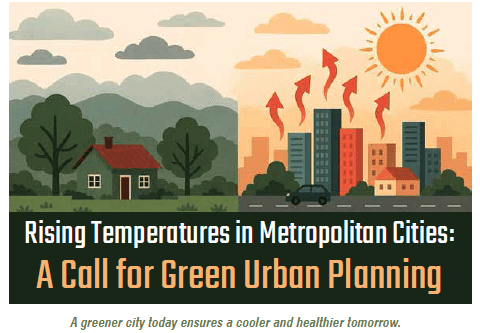
Urban areas contain closely built structures that trap heat between buildings. Waste heat from vehicles, industries, and human activities accumulates because it cannot easily escape into the atmosphere. Even nighttime temperatures remain high because roads and buildings slowly release stored heat.
Urban heat islands also worsen air and water quality. Pollutants become trapped within city landscapes, while warmer runoff water affects aquatic ecosystems.
Strategies for Mitigating Urban Heat Island Effects :
Effective urban planning can significantly reduce heat island intensity.
Green Urban Planning Solutions
- Development of urban green spaces and tree plantations
- Installation of green roofs and rooftop gardens
- Use of light-colored, reflective construction materials
- Expansion of water bodies and urban wetlands
- Promotion of sustainable transport systems
- Adoption of energy-efficient buildings and solar technologies
Vegetation plays a crucial role by lowering temperatures through shade and transpiration, while water bodies act as natural heat sinks.
Urbanization and Climate Change:
Modern environmental challenges such as global warming, air pollution, water contamination, and biodiversity loss are closely linked to uncontrolled urban growth. Increased fossil fuel consumption, deforestation, and excessive concrete infrastructure intensify greenhouse gas emissions and climatic instability.
Human activities—not natural processes alone—are driving sudden climatic changes, leading to extreme weather events, ecosystem disruption, and rising public health concerns.
Conclusion:
Urban heat islands represent one of the most pressing environmental challenges facing modern cities. Sustainable urban planning, environmental awareness, and community participation are essential to create healthier and more livable cities.
Green infrastructure, responsible urban development, and climate-sensitive policies can transform metropolitan areas into environmentally resilient spaces. The future of urban living depends on balancing development with ecological sustainability.
A greener city today ensures a cooler and healthier tomorrow.
ABOUT THE AUTHOR
Mrs. SHWETA RUSHIKANT SATPUTE is a distinguished academician, researcher, and administrator currently serving as the Officiating Principal at Yeshwant Mahavidyalaya. She is pursuing her Ph.D. in Environmental Science at Rashtrasant Tukadoji Maharaj Nagpur University. She completed her Master’s degree in Environmental Science from the same university. She possesses over 15 years of professional experience in research, teaching, and academic administration. Mrs. Satpute has worked for 5 years as a researcher at National Environmental Engineering Research Institute (NEERI), Nagpur. Her research work reflects a strong commitment towards environmental sustainability and scientific advancement. She also has more than 10 years of experience in teaching and institutional administration. She has guided and inspired students through her academic leadership and dedication to education. Mrs. Satpute has actively participated in national and international academic platforms. She has presented and published research papers in international conferences. Her areas of interest include environmental conservation, sustainable development, and higher education. Through her academic excellence and leadership, she continues to contribute significantly to the field of Environmental Science.
DR. SATISH PANDURANGJI REWATKAR has been awarded a Ph.D. in Marketing from Rashtrasant Tukadoji Maharaj Nagpur University. He completed his MBA in Finance and Marketing Management from C.P. and Berar College. He holds professional certifications in Research Methodology, Human Resource Management & Industrial Relations, Management of Public Relations & Communication, and Innovation & Start-up Policy. Dr. Rewatkar possesses more than 18 years of diverse professional experience. His expertise spans Government Administration, Policy Making, Sales, Marketing, and Business Development. He has also contributed significantly in the fields of teaching, research, start-up development, and incubation. He has been actively associated with academic, administrative, and entrepreneurial initiatives. Dr. Rewatkar has presented and published around 18 research papers in various national and international conferences and journals. His areas of interest include urban governance, public policy, management studies, entrepreneurship, and innovation ecosystems.
He is known for his multidisciplinary approach combining academics, governance, and practical industry experience. Through his research and professional contributions, he continues to support knowledge development and institutional growth. His work reflects a strong commitment towards education, innovation, and sustainable organizational development.

Satpute

Dy Chief Business Development- BMC