



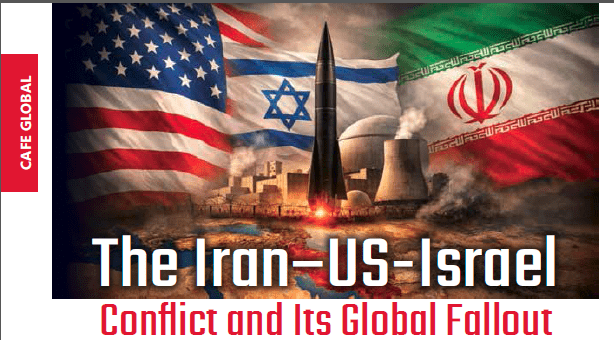
For decades, tensions between the United States and the Islamic Republic of Iran simmered beneath the surface of Middle Eastern geopolitics. But early this year, a long period of proxy clashes, diplomatic standoffs, covert strikes, and strategic competition erupted into open conflict. What began as concerted military action eventually became a direct confrontation involving missile strikes, retaliation, and sweeping economic disruption—including the effective shutdown of the Strait of Hormuz, a critical artery of the global energy system.
This is a story not only of why Iran and the United States are now at war, but what led to this historic rupture, how events unfolded, and why it matters deeply to nations across the world, including India.
From Diplomatic Frictions to War
To understand the 2026 conflict, we must look back over the last half century of U.S.–Iran relations. After the 1979 Iranian Revolution, which overthrew the U.S.-supported Shah regime and established a theocratic republic, Iran pivoted sharply away from Western influence and aligned itself with anti-Western regional actors. This new orientation put Tehran at odds with American strategic interests in the Middle East, from Israel to the Gulf monarchies.
Over the decades, tensions manifested in indirect ways—proxy wars in Iraq, Lebanon, Syria, and Yemen, economic sanctions over Iran’s nuclear program, and occasional skirmishes at sea or in cyberspace. Both sides cultivated allies and militias, seeking strategic advantage without sparking open warfare—until this year.
The fragile equilibrium broke amid a period of intensified airstrikes and counter-strikes. In late February, the United States and Israel conducted a coordinated missile and air campaign targeting senior Iranian leadership and key military installations. It was a dramatic escalation designed to degrade Iran’s capacity for regional asymmetric warfare.
In these strikes, Iran’s Supreme Leader, Ayatollah Ali Khamenei, was killed when his compound in Tehran was hit. Iranian state media confirmed his death, alongside several senior military figures and, tragically, members of his family.
This marked a profound turning point—never before had the leadership of the Islamic Republic been struck so directly. Once considered a remote possibility, the death of Iran’s Supreme Leader removed the central pillar of its political and ideological structure and plunged the country into shock and grief.
Iranians across the region and elsewhere mourned his death, and Tehran immediately denounced the attacks as an unprecedented violation of its sovereignty. Iran’s President, Masoud Pezeshkian, who is part of the nation’s interim leadership, vowed that retaliation was both a duty and a right, signalling that Tehran would respond forcefully.
From Retaliation to Widespread War
Iran’s response was swift and widespread. Revolutionary Guard units launched ballistic missile and drone strikes against U.S. military bases in the Gulf, including in countries such as Qatar, Bahrain, Kuwait, and the United Arab Emirates.
The violence spread quickly. American service members were killed in direct combat operations as U.S. forces engaged Iranian targets and defended regional partners. Casualties mounted on both sides, but more so among Iranian civilians, army personnel, and militia fighters as hostilities expanded.
Diplomatically, the conflict fractured international forums. The United Nations convened emergency sessions as world leaders called for de-escalation, but no clear path forward emerged. Furthermore, Europe was left voiceless and not part of any decision-making process, and for once, they were left high and dry.
The Closure of the Strait of Hormuz: A Strategic Flashpoint
Among the most consequential moves in this conflict was Iran’s declaration that the Strait of Hormuz was closed, warning that any vessel attempting to transit would be set aflame by Revolutionary Guard forces.
The Strait of Hormuz is the narrow maritime passage linking the Persian Gulf to the Gulf of Oman and the Arabian Sea. It carries roughly 20% of the world’s seaborne crude oil and significant volumes of liquefied natural gas from Gulf producers, including Saudi Arabia, Iraq, the UAE, Kuwait, Qatar, and Iran itself.
Although nations normally dispute whether this declaration amounts to a legal blockade under international law, in practice, shipping has slowed dramatically. Major global shipping firms have paused operations in the region, and insurers have cancelled risk coverage amid the threat environment, thereby effectively strangling traffic through the strait.
This has instantly disrupted global energy markets. Fears of supply shortages have driven oil prices sharply upward, with those prices reverberating through financial markets around the world. The closure also impacts global shipping networks more broadly; container traffic, raw materials, and manufactured goods depend on reliable sea lanes that are now imperilled.
Global Consequences of the Conflict
The ramifications of this war are far from regional. Energy markets, financial systems, and diplomatic alliances have all felt the impact.
The potential shutdown of one of the most vital chokepoints for global oil supply threatens to push energy prices higher and fuel inflation worldwide. Even temporary disruptions in Hormuz increase premiums on oil and gas, affecting consumers and industries globally. Insurance costs for tankers and commercial vessels in transit have soared amid the high-risk environment.
Stocks, commodities, and currency markets are processing the new risk landscape. While some investors initially treated the conflict as manageable, prolonged instability could provoke deeper sell-offs or volatility in risk assets.
The war has forced countries to rethink their alliances and strategic dependencies. U.S. partners in Europe and Asia urge restraint, while Gulf states navigate competing pressures from Tehran and Washington. China and Russia, both heavily dependent on Middle Eastern energy flows, have called for restraint and diplomatic solutions, highlighting a potential rift between global powers.
India’s Strategic and Economic Stakes
For India, the consequences of this war are multi-dimensional.
India imports a large majority of its crude oil and a significant proportion of its LNG requirements, with much of that cargo sailing through the Strait of Hormuz. Disruptions in that waterway have immediate effects on India’s energy supply, pushing up costs and complicating long-term planning for refiners and government importers.
Indian shipping companies have been advised to avoid West Asian ports and the Persian Gulf given the risk environment. Ships already transiting the area are being monitored by the Indian Navy, with dozens of vessels in the region flagged for extra caution.
Higher freight costs, insurance premiums, and potential detours around Africa rather than through the Red Sea or Hormuz could increase the cost of trade across India’s supply chains.
India’s traditional foreign policy principle of strategic autonomy is being tested. New Delhi maintains important relations with the United States, the Gulf Cooperation Council—particularly due to large Indian expatriate populations—and has also cooperated with Iran on projects like Chabahar Port and regional connectivity initiatives.
No one can say for certain whether the 2026 Iran–U.S.–Israeli conflict will surge into an even broader war, or whether rising international pressure will eventually force a ceasefire. But Trump has publicly announced that this is going to be longer than what he had originally planned, indicating a prolonged conflict.
If the Strait of Hormuz remains effectively closed, the global economy may face prolonged energy instability that could resonate for months or years. For countries like India, that means accelerating strategic planning—diversifying energy sources, securing alternative logistics routes, and sharpening diplomatic channels to mitigate risk.
This conflict is about far more than oil, territory, or regional dominance. It is a turning point in the global order—one that will shape international relations and energy systems well beyond the Middle East.