



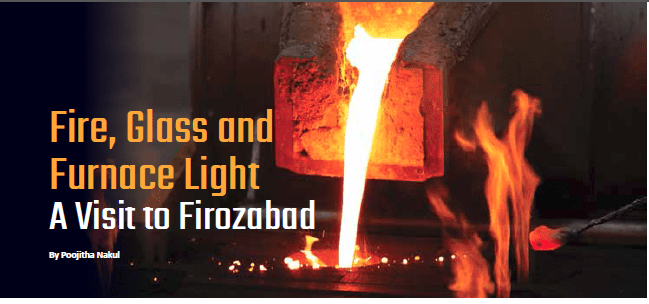
Many cities are defined by monuments, rivers, and geographical features. But some, like Firozabad in Uttar Pradesh, are defined by fire. Often called the “Glass Capital of India,” Firozabad is a city where the blast furnaces never truly sleep. Molten glass glows through the night, steel rods shimmer in orange light, and delicate bangles that will adorn the wrists of women across India are born in intense heat.
My visit to this remarkable city’s industrial cluster was not merely industrial tourism; it was an exhilarating immersion into craft, scale, sustainability, and human endurance.
A Legacy Forged in Fire
Firozabad’s history dates back several centuries and is believed to have been founded in the 16th century during the Mughal period, possibly under Emperor Akbar. The region’s proximity to Agra, once the Mughal capital, played a crucial role in its development. Glassmaking traditions are said to have evolved under Mughal patronage, when artisans were encouraged to produce decorative items for royal courts.
Over time, the craft moved from small-scale artisanal production to organized industrial clusters. What began as handmade glassware gradually transformed into a dense ecosystem of furnaces, workshops, and factories. Today, Firozabad stands as India’s most significant centre for glass bangles and a major producer of glassware and bottles.
A City Defined by Glass
The city’s identity is inseparable from glass. Streets are lined with shops displaying shimmering bangles in every imaginable shade—emerald green, ruby red, royal blue, and translucent gold. Entire neighbourhoods hum with the sound of furnaces and grinding machines.
It is not just an industry here—it is a way of life.
Accessibility and Travel
Firozabad makes for an easy and rewarding side trip from Delhi. Located roughly 250 kilometres from the national capital, it is well connected by road and rail.
By road, one can take the Yamuna Expressway towards Agra and then connect via national highways. The drive takes about 4–5 hours, depending on traffic. By train, several routes connecting Delhi to Agra stop at Firozabad, making the journey comfortable within 3–4 hours.
Its proximity to Agra—home of the Taj Mahal—also makes it an ideal industrial-cultural add-on, offering a striking contrast between marble stillness and molten glass.
The Industrial Ecosystem
Firozabad’s reputation as the Glass Capital is not exaggerated. The city houses hundreds of manufacturing units, ranging from small workshops to large-scale factories. It produces:
- Glass bangles
- Decorative glass items
- Table-top glassware
- Laboratory glass
- Bottles for beverages and pharmaceuticals
What makes the ecosystem remarkable is its recycling model. Used glass bottles are collected, crushed, and mixed with fresh silica and other raw materials before being fed into high-temperature furnaces.
Glass is 100% recyclable without loss of quality. Every broken shard can be melted and reborn. In Firozabad, this is not a concept—it is a daily practice. Workers ensure that every usable piece of glass re-enters the production cycle.
This process is a living example of a circular economy in action.
Inside the Bangle Factory
While bottle-making was impressive, it was the bangle factory that left a deeper impact. Walking into the unit felt like stepping into another world. Temperatures exceeded 1,200°C, and the air shimmered with heat.
Close to a thousand workers operated in a coordinated rhythm—a mix of precision and controlled chaos. From the furnace, workers gathered glowing molten glass using long iron rods and carried it swiftly to the bangle-making deck.
Timing is critical. Glass must be shaped before it cools, yet handled delicately to avoid distortion.
- The molten glass is rolled over steel rods to achieve thickness and diameter
- The continuous tube is cut using a diamond cutter
- The ends are reheated and seamlessly joined into a circular bangle
This process requires exceptional skill, trained eyes, and years of craftsmanship.
The unit I visited produces more than two lakh bangles daily. When one imagines the wrists adorned across India during weddings and festivals, the scale becomes staggering.
Exhilaration and Reflection
The experience was deeply exhilarating. Watching molten glass transform into a perfect circle within minutes felt almost magical. The coordination, sparks, and rhythm of movement created a form of industrial choreography.
Yet alongside the thrill came reflection. The physical conditions are intense—workers operate near extreme heat for long hours in crowded and demanding environments.
There is undeniable resilience and pride, with skills passed down through generations. However, there are also important concerns around:
- Occupational safety
- Labour welfare
- Modernization
Firozabad represents a powerful paradox—immense productivity driven by human endurance.
Tradition Meets Scale
What fascinated me most was how tradition and scale coexist. This is not a fully automated industry. It remains a human-intensive ecosystem that has expanded without losing its manual craftsmanship.
Despite this, the output rivals mechanized systems. Producing two lakh bangles a day from a single unit is a testament to remarkable efficiency.
Conclusion: Fragility Born from Fire
Firozabad is a reminder that fragility can emerge from ferocity.
Bangles—symbols of celebration and tradition—are born in roaring furnaces. Glass bottles, used in everyday life, are reborn from waste through fire.
The city embodies:
- Sustainability without fanfare
- Productivity without glamour
- Artistry without spotlight
My visit was more than industrial exposure—it was an encounter with human skill at scale. It was thrilling, humbling, and deeply reflective.
In the glow of those furnaces, I saw more than glass. I saw livelihoods, tradition, recycling ingenuity, and quiet strength.
And once you witness molten glass turn into a perfect circle, you will never look at a simple bangle the same way again.