


“We are now living in the 21st century, equipped with all the advanced technologies. When we Hindus go back in time to recollect the age of torture, destruction, suppression and humiliation that our forefathers underwent, we should derive inspiration from the fact that when our ancestors worked and survived in such difficult times and conditions, so what stops us from excelling in these technologically advanced times?”
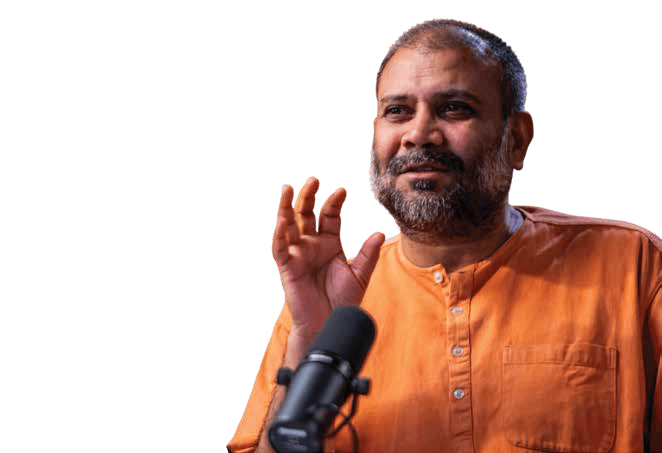
Swami Vigyananand is a Sanyasi of the Dasnami order, established by Jagadguru Adi Sankaracharya at Kailash Ashram in Rishikesh. He has wandered across the length and breadth of Bharat on foot as a wandering monk.
Swamiji has been a Swayamsevak of the Rashtriya Swayamsevak Sangh (RSS) from a very young age and is Tritiya Varsh Shikshit. He has been actively involved in the Ram Janmabhoomi Andolan and was the first Coordinator of the Baba Amarnath Yaatra, which was restarted in 1992 after having been stopped earlier due to terrorism. He is currently the Joint General Secretary of the Vishva Hindu Parishad (VHP) and heads VHP’s Videsh Vibhag (International Division).
After completing his B.Tech. from IIT Kharagpur, Bharat, Swamiji studied and taught Panini grammar and Hindu philosophy. He is a Postgraduate (Acharya) in Panini Sanskrit Grammar and Vedang; Vidyavaridhi (Ph.D.) in Eastern Philosophy, which includes the six schools of Hindu Philosophy (Upang), along with Buddhist, Jain, atheist philosophy, and other Hindu schools of philosophy; and Vachaspathi (D.Litt.) in Brahmana and Vedic Samhita.
He has written several books, including Bibliography of Sanskrit Grammar, Hindu Nam – Tathya & Satya (a linguistic study), and The Hindu Manifesto. Swamiji has travelled many times across the world and attended more than 20 international conferences in different parts of the world, where he has presented papers and chaired many sessions.
In 2009, Swamiji conceived the idea of the World Hindu Economic Forum (WHEF) to connect Hindus across the world on a common economic platform. The founding philosophy of WHEF is Acharya Chanakya’s sutra, “Dharmasya Moolam Arthah,” i.e., economy is the strength. WHEF’s goal is to make society prosperous by creating and sharing surplus wealth.
Apart from WHEF, Swamiji has created six other forums in the fields of education, media, democratic politics, temples and organizations, youth, and women to provide solid institutional platforms for the global Hindu community in these critical areas.
These seven forums meet every four years at the World Hindu Congress (WHC) to deliberate and devise solutions to various challenges facing Hindu society. The first WHC was held in 2014 in New Delhi; the second WHC in 2018 in Chicago, USA; the third WHC in 2023 in Bangkok; and the fourth WHC will be held in Mumbai from 18–20 December 2026.
Swamiji believes:
“We are now living in the 21st century, equipped with all the advanced technologies. When we Hindus go back in time to recollect the age of torture, destruction, suppression and humiliation that our forefathers underwent, we should derive inspiration from the fact that when our ancestors worked and survived in such difficult times and conditions, so what stops us from excelling in these technologically advanced times?”
Swami Ji, what was the inspiration behind starting the World Hindu Congress? What gap did you see in the global Hindu community?
Hindus are flourishing almost everywhere as individuals—in science, business, the arts, and technology—yet we remain underrepresented in strategic spheres of influence such as academia, media, politics, administration, the judiciary, and policymaking.
When a community lacks strategic direction, shared vision, and organized power, its contributions remain scattered, weak, unrecognized, and ultimately less impactful.
The World Hindu Congress was created to address precisely this gap: to provide a global platform where Hindus can come together, think together, and act together with strategic direction, focus, and discipline for the resurgence of Hindu civilization.
Its purpose is to transform individual success into collective strength, visibility, and dignity for Hindus and for Dharma on the world stage.
The theme of WHC has been “Sangachchhadhwam Samvadadhwam” and “Dharma, the Abode of Victory”. How do you see these themes playing out in today’s world?
Each WHC has been guided by a mantra drawn from our sacred texts, because Hindus must take inspiration from these profound sutras:
- WHC 2014 in Delhi: “Sangachchhadhwam Samvadadhwam” (Step Together, Express Together)
- WHC 2018 in Chicago: “Sumantrite Suvikrante” (Think Collectively, Achieve Valiantly)
- WHC 2023 in Bangkok: “Jayasya Aayatnam Dharmah” (Dharma, the Abode of Victory)
- WHC 2026 in Mumbai: “Samānam Vratam Saha Cittam” (Shared Commitment: Collective Resolve)
Taken together, these themes call on Hindus to think deeply, unite internally, and then act bravely and ethically so that Hindu Dharma once again shines as a guiding light for humanity in a confused and fractured world.
What do you consider as the biggest achievement of WHC and WHEF so far?
The World Hindu Congress is not merely a three-day event held once every four years; it is an ongoing movement that brings together Hindu changemakers across seven key pillars of society: economy, education and academia, media, politics, youth, women, and organizations. Throughout the year, work continues in these areas through projects and initiatives aligned with a shared strategic direction.
The World Hindu Economic Forum (WHEF) has brought together financially successful members of Hindu society—including traders, bankers, technocrats, investors, industrialists, businesspersons, professionals, economists, and thinkers—to share knowledge, experience, expertise, and resources with their fellow brethren, with the larger goal of generating surplus wealth and making society prosperous.
We are also encouraging, supporting, and mentoring emerging Hindu entrepreneurs by improving access to markets, capital, and technology. This has led to dozens of local chapters of the Hindu Economic Forum across Bharat and abroad, where Hindus self-organize for mutual growth.
In education and academia, our teams have helped launch postgraduate Hindu Studies programmes and Ph.D. tracks in several universities. They are also actively engaged in faculty and teacher training, as well as curriculum development.
In media, we have convened senior professionals from film, news, entertainment, and advertising to strategize on the challenges and opportunities before Hindu society, while steadily nurturing initiatives in news and entertainment that provide a factual perspective on socio-political issues and offer healthy content rooted in a Hindu worldview.
We are encouraged to see more Hindus across the world entering political life and contributing to public policy, a development that our initiatives seek to support and strengthen.
Our teams have prepared substantive policy papers and proposals on higher education, the economy, and social media regulation, which we have submitted to the government as part of our ongoing advocacy.
In addition, we have launched a project to assess the human rights records of Western and other countries, while also drawing attention to human rights violations faced by Hindus around the world.
Most heartwarming of all, our efforts are helping foster greater participation by Hindu women and youth in leadership across entrepreneurship, advocacy, and social activism.
At the same time, long-standing silos between Hindu socio-religious organizations are gradually giving way to greater interaction, collaboration, and sustained cooperation.