


Some cities preserve their history in museums and monuments. Ahmedabad, however, lives its history every day. Founded more than six hundred years ago, the city continues to carry forward its traditions, architecture, culture, and way of life with remarkable pride. Walking through the old streets of Ahmedabad feels like travelling through time, where every building, market, and neighbourhood has a story to tell. This unique blend of history and living culture earned Ahmedabad the distinction of becoming India’s first UNESCO World Heritage City in 2017.
The story of Ahmedabad began in 1411, when Sultan Ahmad Shah established a new capital on the banks of the Sabarmati River. Legend has it that he was inspired by the courage of a hare chasing a hunting dog, seeing it as a sign of the strength and spirit of the land. Over the centuries, Ahmedabad flourished under the Gujarat Sultanate, the Mughals, the Marathas, and later the British. Despite these changing rulers, the city retained its unique identity and cultural richness.
One of Ahmedabad’s greatest distinctions is that it is not a heritage city frozen in time. Unlike many historic cities where old quarters survive only as tourist attractions, Ahmedabad’s historic core remains a living and thriving community. Thousands of people still reside in homes that have stood for generations. Children play in narrow lanes, families celebrate festivals together, and businesses continue to operate from centuries-old buildings. This continuity of life is one of the key reasons UNESCO recognised the city as a site of outstanding universal value.
At the heart of the old city are its famous pols, traditional residential neighbourhoods that developed as close-knit communities. Originally designed for both security and social harmony, these gated settlements brought together people of similar professions and backgrounds. Walking through the pols is among Ahmedabad’s most memorable experiences. Narrow shaded lanes remain cool even during the hot summers, while beautifully carved wooden façades, ornate balconies, colourful doors, decorative windows, and open courtyards showcase exceptional craftsmanship. Bird feeders known as chabutras reflect the city’s long-standing tradition of caring for animals and birds, while the overall design demonstrates how earlier generations adapted architecture to the local climate.
Ahmedabad’s architecture reflects a remarkable fusion of Hindu, Jain, and Islamic traditions. Local artisans borrowed ideas across cultures, creating a distinctive architectural style found nowhere else in India. This cultural harmony is evident in some of the city’s finest monuments.
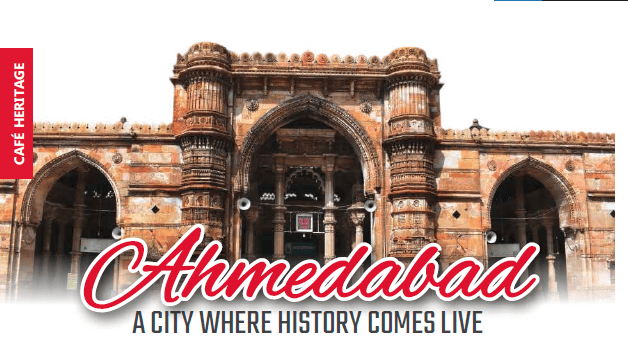
Among them is the magnificent Jama Masjid, built by Sultan Ahmad Shah in 1424. Considered one of India’s finest mosques, its vast courtyard, elegant arches, and rows of intricately carved pillars create an atmosphere of peace while showcasing the engineering excellence of medieval Gujarat.
Equally iconic is the Sidi Saiyyed Mosque, renowned for its extraordinary stone lattice windows. Its famous “Tree of Life” carving has become one of Ahmedabad’s most recognisable symbols. Delicate and intricate, the stonework appears almost like lace carved from rock and continues to attract admirers from around the world.
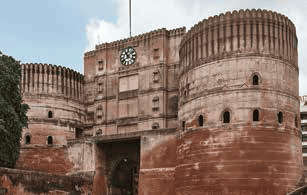
The Bhadra Fort, built soon after the city’s foundation, served as the centre of political and administrative life. Nearby stands Teen Darwaza, the historic triple gateway that once marked the entrance to the royal square. The elegant Hutheesing Jain Temple, built in the nineteenth century, is another architectural gem celebrated for its exquisite marble carvings and graceful design.
A short distance from the city lies the spectacular Adalaj Stepwell, one of Gujarat’s greatest architectural treasures. Built in the fifteenth century, this five-storey structure served as both a water source and a resting place for travellers. Its beautifully carved pillars, galleries, and chambers demonstrate the ingenuity of traditional Indian engineering while remaining pleasantly cool even during summer.
Beyond its monuments, Ahmedabad offers countless cultural experiences. One of the best ways to discover the city is through its heritage walks, which guide visitors through hidden temples, historic homes, bustling markets, and centuries-old traditions. These walks reveal how history continues to shape everyday life.
Shopping is another major attraction. Once known as the “Manchester of India,” Ahmedabad built its reputation on textiles and craftsmanship. Visitors can explore Bandhani fabrics, embroidered garments, handcrafted jewellery, wooden artefacts, and colourful Gujarati textiles. Markets such as Law Garden, Dhalgarwad, and Rani-no-Hajiro provide a vibrant glimpse into the city’s entrepreneurial spirit and artistic traditions.
No visit to Ahmedabad is complete without experiencing its food. Gujarati cuisine is celebrated for its delightful balance of sweet, spicy, and savoury flavours. Popular dishes such as dhokla, khaman, handvo, khakhra, and fafda-jalebi are enjoyed throughout the city, while a traditional Gujarati thali offers a rich variety of regional specialities on a single platter.
One of Ahmedabad’s most unique culinary destinations is Manek Chowk. During the day, it functions as a bustling jewellery market, but after sunset, it transforms into a lively street-food paradise. The colourful stalls, tempting aromas, and energetic crowds perfectly capture the city’s vibrant spirit.
Ahmedabad also occupies a special place in India’s freedom movement. It was here that Mahatma Gandhi established the Sabarmati Ashram, which became the centre of several important campaigns against British rule. Today, it remains one of the city’s most significant attractions and a powerful reminder of India’s struggle for independence.
Modern Ahmedabad stands at the crossroads of tradition and progress. Expanding industries, educational institutions, business centres, and modern infrastructure coexist with ancient monuments and historic neighbourhoods. Despite rapid urban growth, the city has successfully preserved the character of its historic core, making it a model for balancing conservation with development.
The Historic City of Ahmedabad is far more than a collection of monuments. It is a living testimony to centuries of cultural exchange, architectural innovation, commercial prosperity, and community life. Its streets tell the stories of sultans, merchants, craftsmen, freedom fighters, and ordinary citizens whose legacy continues to shape the city.
For visitors, Ahmedabad offers an experience that is both educational and deeply human. Here, history is not confined to textbooks but can be seen, heard, tasted, and felt. Whether admiring intricate carvings, wandering through ancient pols, shopping for traditional crafts, or enjoying legendary street food, Ahmedabad leaves a lasting impression.
It remains one of India’s most remarkable cities, a place where the past and present walk hand in hand, creating a heritage that continues to inspire the world.
By Poojitha Nakul