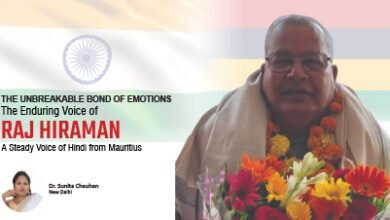



“I carry not just their names, but their souls. I offer them the arghya of words.” ~ Ramdev Dhurandhar
In the quiet corners of Port Louis, Mauritius, lives a man whose story stretches across oceans and generations. Ramdev Dhurandhar was born in Deoria, Uttar Pradesh, India, but life carried him and his family far from home. Today, he stands as a proud keeper of memories, a writer who turns the pain of the past into powerful literature. His journey reminds us that no distance can truly separate a heart from its roots.
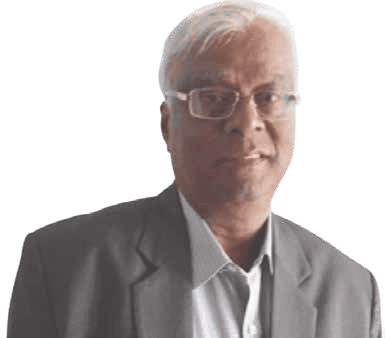
I first came to know of him through Ali Sir, who met Dhurandhar ji at a literary gathering in Port Louis. What struck Ali Sir most was the writer’s warmth and simplicity. Here was a respected author who greeted others with genuine affection, using respectful terms for everyone he met. There was no pride in his achievements, only a deep, quiet sorrow for the Indians who had left their homeland long ago and made Mauritius their new home.
Dhurandhar ji explained that the first group of Indian workers reached Mauritius in 1834 or, more truthfully, were brought there under the harsh indenture system. His own father was born in 1897, when this movement of people was still continuing. These labourers lived in poor, shed-like houses under British control. They worked as bonded workers, facing endless hardship. Some Indians, sadly, sided with the British and became overseers who whipped their own fellow Indians. This betrayal left a lasting wound in Dhurandhar’s heart.
His father, though uneducated, was a man of strong vision. He pushed his son to study and never let him lack the basic needs. In the boy’s room, he placed a simple calendar picture of Goddess Saraswati and told him to pray every day for knowledge. That picture stayed on the wall long after its year ended. Later, when Dhurandhar built his own house, he gave Maa Saraswati a permanent place of honour.
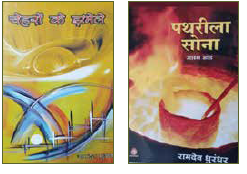
In 1976, he wrote the powerful play Itihas ka Dard (The Pain of History). Through it, he brought to life the tears, poverty, daily struggles, and deep suffering of the displaced Indians. He wrote movingly that while remembering their names, he was also carrying their souls. He wanted to offer them words as sacred tribute. This same spirit flows through his six-volume work Pathrila Sona (Stony Gold), where the hidden pain of these uprooted lives finds a lasting voice.
Nature has always touched Dhurandhar ji deeply. When he walks near a mountain and sees a mango tree, his heart fills with emotion. He feels sure that one of his ancestors must have planted it. In Mauritius, he has lovingly renamed the flowing rivers as “Manua River” and several mountains as “Vindhya,” creating his own bridges back to India.
He often recalls the terrible stories of those times: dogs were set loose on workers who tried to run away; stones were rolled down into wells on men digging below. The life of bonded labourers was full of cruelty and despair. Dhurandhar’s own path was not easy. After his two elder brothers married and moved away, he stayed behind to support his parents and three younger siblings. He took up any work he could find, digging with a spade and doing manual labour, all to feed the family. The famous lines from the film Mother India became his daily truth: “Dunia mein hum aaye hain to jeena hi padega…”
When his father fell ill and passed away, the responsibility grew heavier. With help from Hindi Pracharini Sabha, he continued his studies. In his Hindi class of thirty students, two were his own children. Poverty was a close companion; even bus fare was sometimes hard to manage. He once tried to join the police for a stable income but did not succeed. Yet through steady determination and hard work, he slowly built a stable life.
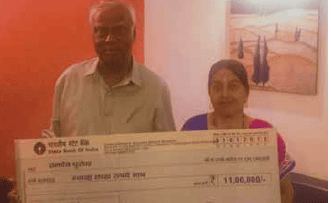
All through these struggles, literature remained his true calling. He wrote novels such as Chehron ka Aadmi, Chhoti Machhli Badi Machhli, Poocho Is Maati Se, and Bante Bigadte Rishte. His story collections include Vishwamanthan and Janm ki Ek Bhool. His sharp satirical works, Kalyugi Dharm, Chehron ke Jhamеле, and Bande Age Bhi Dekh, earned him the respected Shri Lal Shukla Award, along with a prize of ₹11 lakh.
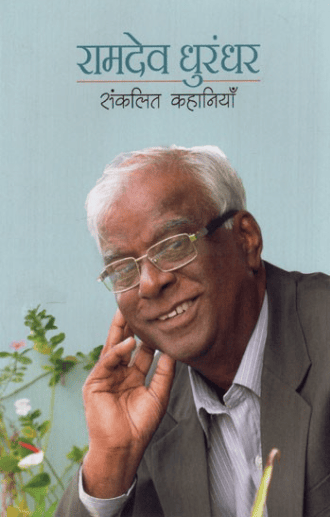
Today, Ramdev Dhurandhar lives simply. He dresses modestly and meets everyone with a kind smile. Though he is Mauritian by residence, his bond with India remains strong and beautiful. The soil, the food, and the sacred places of India keep calling him back. Indian culture fills his home, and every Indian visitor receives his warm, heartfelt welcome. He loves every Indian, no matter where they live.
Exclusive Interview with Ramdev Dhurandhar
Question: What drives your writing about the indentured labourers’ pain even today?
Ramdev Dhurandhar: Their sacrifices are etched in my soul. Writing is my way of honouring their unvoiced suffering and ensuring the world never forgets.
Question: How does living in Mauritius influence your connection to India?
Ramdev Dhurandhar: Every mountain and river here reminds me of Vindhya and Ganga. Distance has only deepened my love. India lives in my heart.
Question: Which of your works is closest to your heart?
Ramdev Dhurandhar: Itihas ka Dard, it was born from raw emotion. I felt I was carrying the souls of my people.
Question: Any dream yet unfulfilled?
Ramdev Dhurandhar: To see more Indian youth visit Mauritius and feel the emotional bond our community shares with Bharat Mata.
Question: What would you like to say to our readers?
Ramdev Dhurandhar: Dear readers, whether you live in India or abroad, hold your heritage close to your heart. Every story of struggle carries seeds of hope and resilience. Let us keep the eternal light of our culture, language, and values burning brightly together. Bharat Mata ki Jai!
Ramdev Dhurandhar’s life shows us that pain can become purpose and distance can deepen love. His story is not just about one man’s success; it is about the quiet strength of an entire community that refused to forget its roots. In his words, struggles, and unwavering devotion, we see the true spirit of India shining brightly across borders. He proves that no matter where life takes us, the thread connecting us to our motherland remains unbreakable, turning every scar into a story worth telling and every tear into a tribute that inspires generations to come.